The waystation counted Mara Vey before it let her in.
She heard it in the door: one soft wooden knock from somewhere inside, though the brass key had not yet turned and the building had been empty for eleven years.
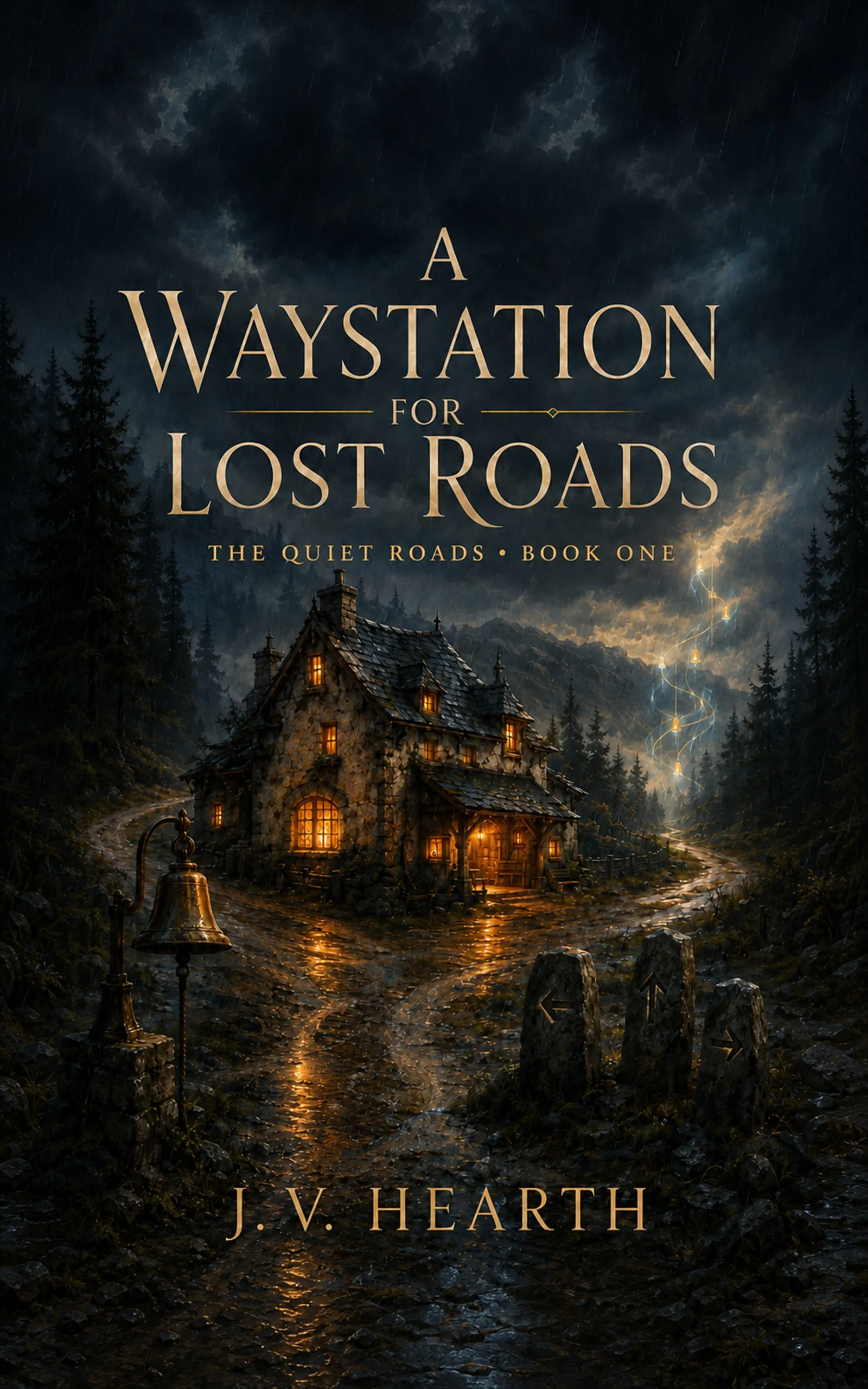
Rain moved over the Quiet March in slanting grey sheets. It had soaked the shoulders of Mara’s coat, the salvage charter in her inner pocket, and every hopeful idea she had entertained during the walk from Bellwether. Gannet stood at the junction like a bird too old to fly: pale stone gone green at the footings, slate roof sagging above the east wing, brass finial bent toward the road. Three roads met before its yard. A fourth bell rope hung behind the front window.
There was no fourth road.
Mara set down her carpetbag beneath the porch, where the rain found her anyway, and tried the key again.
It went halfway.
“Of course,” she said.
The Office of Roads had described the lock as serviceable. The Office used serviceable the way undertakers used peaceful.
She took a narrow tin from her bag, worked lamp oil into the keyhole with a pin, and leaned her shoulder against the door. The hinges answered with a long complaint. The lock turned. For one moment nothing happened.
Then the door drew itself inward by the width of a finger.
A smell came out: cold ash, wet plaster, mouse nests, and something mineral beneath them, like stones struck together in darkness.
Mara looked back at the junction. Bellwether was three miles east, its chimney smoke blurred by weather. The northern road climbed empty toward the quarry. The west road disappeared into rain and low thorn. Her hand could still leave the key in the door. She could return to the room above the cooper’s shop, tell the Office the structure was unsafe, and spend the last of her savings discovering how long a person could live on correct filing habits.
The door knocked once more from within.
One.
“I heard you,” Mara said, and stepped inside.
The entrance hall had been made for traffic. Benches lined both walls. Pegs waited for cloaks. A wide arch opened toward a common room where twelve tables stood under dust sheets. On the far wall, an iron hearth was large enough to roast an ox and cold enough to preserve one.
Four bell ropes hung beside the reception desk.
Their handles were painted with faded road colours: quarry ochre, Bellwether blue, west-road green, and plain black. The black rope had been tied high against its bracket, out of ordinary reach. A lead seal stamped with the wheel-and-ruler of the Central Office clamped it to the wall.
Mara made herself look away.
She laid the salvage charter on the desk. Its red ribbon had bled onto the page.
TEMPORARY OCCUPATION AUTHORISATION
CHARTERHOUSE GANNET, REGIONAL REGISTER 18-C
CLAIMANT: MARA VEY
PURPOSE: ASSESSMENT, RESTORATION, OR ORDERLY DISSOLUTION
The final phrase had been added in a different hand.
She found the station ledger in the lowest drawer, swollen with damp but present. The last entry was dated eleven years earlier.
No keeper appointed. West guest wing closed. Hearth surrendered at sunset. May Gannet be remembered as willing.
Below it, in an ink that had browned almost to gold, someone had drawn a small bird.
Mara touched the page. The building settled around her, beam by beam, as though releasing a breath it had saved too long.
“Assessment first,” she said. “Sentiment after.”
It was a rule she had once been good at.
She spent the afternoon opening shutters, marking cracked lintels in chalk, and discovering the limits of the Office inventory. The roof did not merely leak in six places. It leaked in six rooms, each with several opinions about where water belonged. The pantry contained three jars of salt, a fossilised onion, and a family of mice with established tenancy. The pump produced a cough of rust.
The common-room hearth was intact, but its charter plate had gone blank.
Every licensed waystation carried its public rights in brass above the fire. Most had at least Fire and Shelter. Large stations could hold Witness, Exchange, Passage, Healing, Sanctuary, or a dozen narrower privileges earned over generations. Gannet’s plate showed four dark rectangles, each empty except for scratches where letters had once sat.
Rights could not be transferred with a deed. They were not possessions. A keeper and station earned them together by fulfilling the duty they named.
Mara had read that sentence in training. She had never seen it matter.
By late afternoon, the rain had deepened into a hard, steady drumming. She found dry wood in a locked shed, carried in two armfuls, and arranged kindling beneath the hearth grate. Her match caught. The flame bent blue, shivered, and went out.
The second did the same.
On the third attempt the smoke blew into the room, though the flue was open.
Mara sat back on her heels. “You could make this easier.”
A drop fell down the chimney and struck the cold grate.
“Fair.”
She was cleaning soot from the draft lever when the west-road bell moved.
Not rang. Moved.
The green-handled rope pulled taut, slackened, and pulled taut again.
Mara stood so quickly that her knee cracked against the fender. Nobody was licensed to ring from the road. The exterior bellpost had rotted through years ago.
The station gave one low thud through its front door.
Then another.
Two.
Mara crossed the hall. Wind pressed rain under the threshold. When she opened the door, a broad man in a flour-coloured coat nearly fell across it.
He caught himself on the jamb. A wooden bread chest was strapped to his back beneath an oilskin. Blood ran from a cut above one eyebrow, diluted pink by the rain.
“Evening,” he said. “I recognise this is not a persuasive entrance.”
Mara looked past him. The west road was gone behind a white wall of water.
“Were you followed?”
“Only by weather. It has shown unusual commitment.”
“You’re injured.”
“I had hoped the blood would establish that.”
The sensible response was to direct him to Bellwether. Gannet was unlicensed, uninsured, structurally uncertain and currently unable to boil water. Admitting a guest created duties. Charging him would be unlawful until the station’s rates were registered. Admitting him without charge might be construed as operating.
The man swayed once.
“What is your name?” Mara asked.
“Tovin Brindle. Baker, presently damp.”
“Can you walk three miles?”
“Not in the direction the road has chosen.”
Mara looked west again. The surface of the road had begun to shine beneath the runoff, not with puddles but with a smooth dark gloss. For half a heartbeat she saw two rows of milestones where there should have been one. The second row leaned away at an impossible angle.
Then lightning flattened the view.
Tovin’s fingers tightened on the jamb. “There was a turn back there that wasn’t there this morning.”
The Office would call that a road-weather event. A keeper would call it somebody at the door.
Mara stepped aside.
“Come in.”
“What’s the rate?”
“There is none.”
His expression sharpened despite the blood. “No rate posted, or no rate?”
“No price for shelter from lethal weather.”
The door knocked once beneath her hand.
She had said the words without remembering where she knew them from. Then she saw the sentence carved into the inner lintel, nearly hidden beneath old whitewash.
FIRE HAS NO PRICE IN WEATHER THAT KILLS.
Tovin crossed the threshold.
The front door slammed behind him with enough force to shake water from the rafters. The green bell rang once, deep and clean.
In the common room, iron scraped stone.
Mara and Tovin stared at each other.
“That,” Tovin said, “was either encouraging or expensive.”
They found the hearth grate pulled open. The wood Mara had laid was still damp at the edges, but a coal glowed beneath it where no coal had been before.
She crouched and held out her hand. Heat touched her palm.
Not much. Enough.
“Sit,” she told Tovin. “Coat off. Let me see the cut.”
He obeyed with the grave concentration of a man who had decided collapse was a privilege best enjoyed indoors. Mara cleaned his forehead with boiled water from the kettle she had thought they could not boil. The coal took the kindling, the kindling took the split wood, and warmth began to move through the common room.
It did not move like ordinary heat. It travelled deliberately. First to Tovin’s soaked boots. Then to the blanket around his shoulders. Then down the entrance hall, drying the threshold where rain had crossed.
The brass plate above the hearth clicked.
Mara turned.
Letters rose from the first dark rectangle as if pressed from behind.
FIRE.
The word held a dull red glow. Beneath it, smaller text appeared in strokes no wider than a hair.
Freely given. Freely kept. One life admitted in need.
Tovin read over her shoulder. “I have been called worse things than one life.”
Mara put two fingers against the plate. The brass was warm.
A Right of Fire. Earned in under an hour, after eleven empty years.
She should have felt triumph. Instead she felt the old, dangerous sensation of a record changing beneath her hand.
“What happened on the west road?” she asked.
Tovin loosened the straps of his bread chest. “Rain started at the boundary stone. Then I passed the same hawthorn three times. On the fourth, there was a side road.”
“There is no side road between the old lime kiln and Gannet.”
“I know. That was its most memorable quality.”
“Did you take it?”
“I did not. Something had hung forty-three little lamps along it, and I have survived this long by declining invitations that count themselves.”
Mara’s hand went still on the brass.
“Forty-three?”
“Near enough. I was being rained on.”
Behind them, in the entrance hall, the tied black bell rope gave a small, dry creak.
Neither of them had touched it.
The hearth flared. For an instant, soot on the chimney breast formed the curve of a road leading somewhere beyond the wall.
Then the fire settled, and the mark was gone.